
- By Sarju Saran Tiwari
- Fri, 17 Apr 2026 06:38 PM (IST)
- Source:JND
El Niño Climate Phenomenon 2026: The world's oceans are sending a warning signal that climate scientists cannot ignore. Deep beneath the surface of the Pacific, temperatures are climbing in a pattern that meteorologists have seen before, but rarely at this scale. Experts are now openly discussing the possibility of a "Super El Niño," a rare and devastating climate event that could rewrite weather records across continents and push global temperatures to heights never seen in recorded history.
What makes this moment particularly alarming is the backdrop against which it is unfolding. The planet has already been warming steadily due to climate change, and scientists warn that this underlying heat acts as fuel, making any El Niño event hit harder, last longer, and cause more destruction than it would have decades ago. The most recent El Niño, which occurred in 2023–24, was already among the five strongest on record and contributed directly to the record-breaking global temperatures of 2024.
Now, with fresh data emerging and forecasting models aligned in one direction, government agencies, meteorological departments, and climate organisations worldwide are urging preparation. Whether a full-blown Super El Niño materialises or not, the probability of a significant disruption to global weather is high enough that waiting and watching is no longer a responsible option.
What Is El Niño?
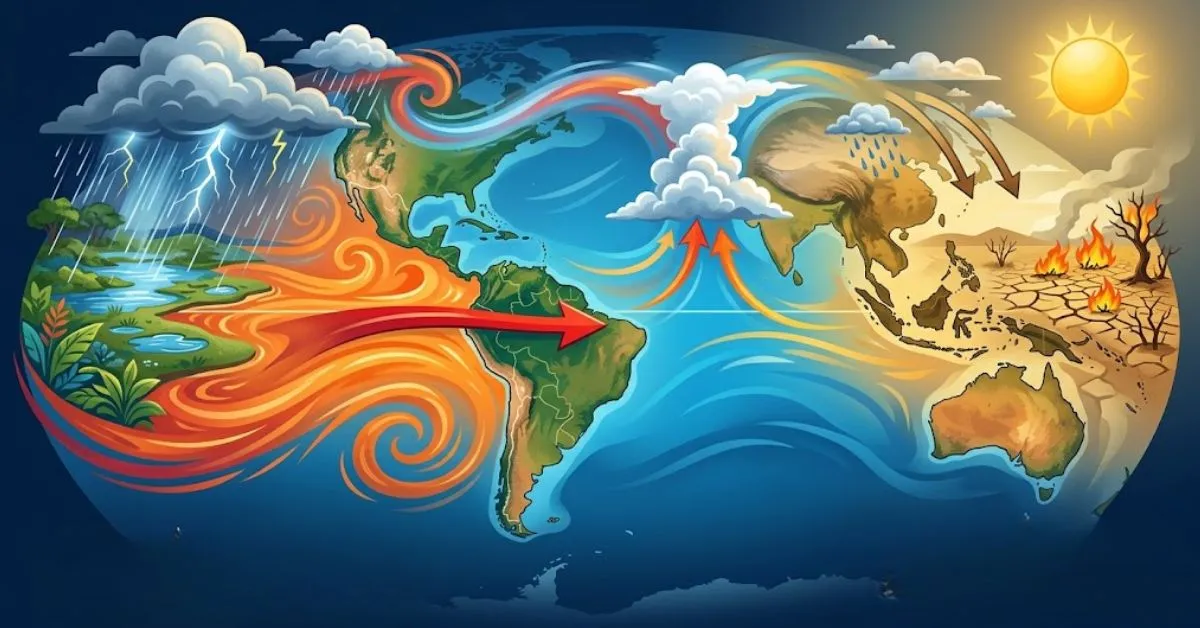
El Niño is a natural climate phenomenon rooted in the relationship between the Pacific Ocean and the atmosphere above it. Under normal conditions, strong trade winds push warm surface water westward across the Pacific. But every few years, those winds weaken or change direction, allowing warm water to pool in the central and eastern tropical Pacific instead.
When sea surface temperatures in that region rise by at least 0.5°C above the historical average, scientists declare an El Niño event has begun. This seemingly small shift in ocean temperature has enormous consequences: it disrupts jet streams, flips rainfall patterns, and can send global temperatures surging. Together with its cooler counterpart, La Niña, and a neutral state in between, El Niño forms part of a climate cycle known as ENSO- the El Niño–Southern Oscillation, which shifts roughly every three to seven years.
What Is Super El Niño?
A Super El Niño is not simply a stronger version of a regular El Niño; it is a categorically more dangerous event. The threshold is defined by sea surface temperatures spiking by at least 2°C above normal, and since 1950, this has happened only a handful of times. On just one occasion have temperatures pushed past 2.5°C.
The last Super El Niño struck in 2015, and the damage was sweeping. It triggered severe drought in Ethiopia, water supply crises in Puerto Rico, and an unprecedented hurricane season across the central north Pacific. Scientists have noted that the higher ocean temperatures rise, the more violently the climate system responds, with floods, droughts, and heatwaves all supercharged simultaneously in different corners of the world.
Also Read: What Is Delimitation Bill 2026? A Look At How Many Times India Has Redrawn Constituency Boundaries
How Will It Affect India's Upcoming Weather Pattern?
For India, the stakes are particularly high. The India Meteorological Department has already projected that monsoon rainfall in 2026 is likely to be below normal, at around 92% of the long-term average. This deficit, if a Super El Niño takes hold, could deepen considerably.
El Niño events historically suppress the Indian summer monsoon by disrupting the moisture-laden winds that carry rainfall from the Bay of Bengal and Arabian Sea across the subcontinent. A stronger El Niño means a weaker monsoon; and a weaker monsoon means reduced rainfall, intensified heat waves, damaged crop yields, and mounting water scarcity across large parts of the country. Agriculture, which still supports hundreds of millions of livelihoods in India, is especially vulnerable to such disruptions.
Beyond agriculture, heat stress on urban populations, pressure on water reservoirs, and surging energy demand during summer months all represent compounding risks. Experts are clear: even if the Super El Niño scenario does not fully materialise, the probability of a significant El Niño is high enough that India must begin preparing now, from crop planning and water management to public health advisories.
For India, a Super El Niño could entail:
-Reduced rainfall
-Higher temperatures
-Adverse effects on agriculture
-Water scarcity
Conversely, other parts of the world could face an increased risk of heavy rainfall and flooding.
Is it certain that a Super El Niño will occur?
No, Scientists note that making precise weather forecasts during the spring season is challenging. However, the current indicators strongly suggest the potential emergence of a robust El Niño- or even a Super El Niño.