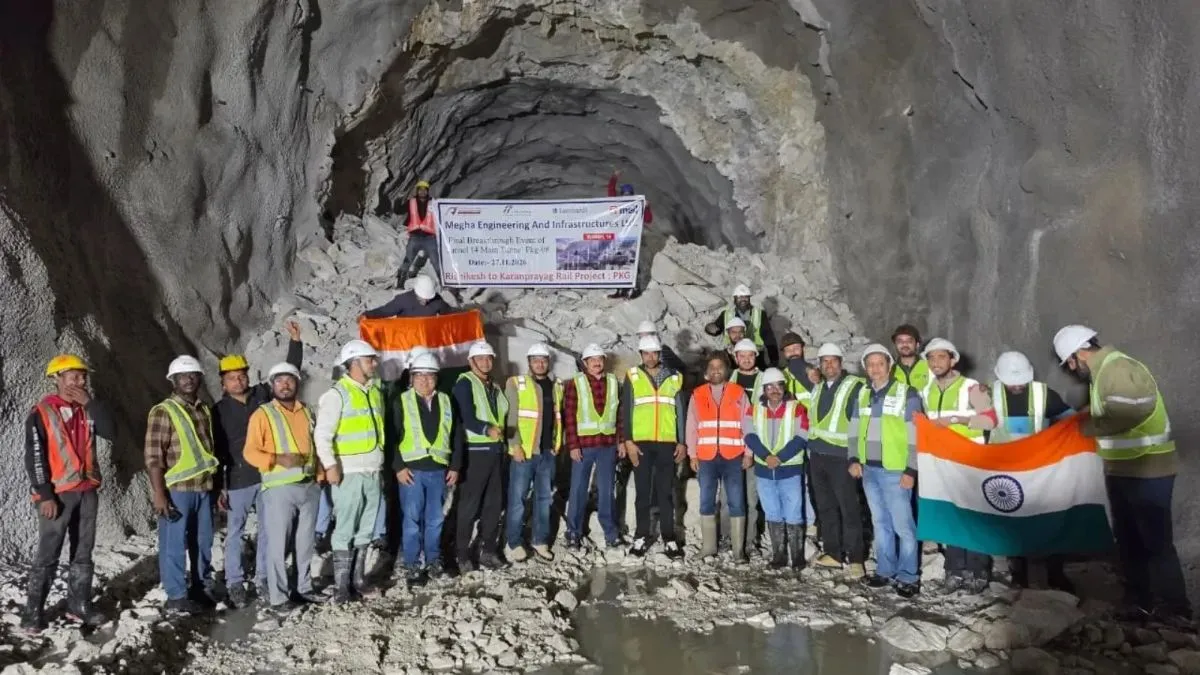
- 6.59-km Tunnel-14 breakthrough achieved in Rudraprayag district.
- Rishikesh-Karnaprayag rail project 79% complete overall.
- Targeted completion by December 2029 for Himalayan corridor.
Rishikesh-Karnaprayag Rail Project: Indian Railways has achieved a major breakthrough in the 6.59-km Tunnel-14 on the 125-km Rishikesh-Karnaprayag railway project in Uttarakhand's Rudraprayag district. The milestone connects two excavated stretches, 4.7 km from Portal-1 at Sumerpur and 1.79 km from Portal-2 at Marora, advancing the Himalayan rail corridor toward completion.
How Engineers Built Tunnel-14 Safely
At Portal-1, engineers dug a 110-metre stretch of the three-track tunnel through unstable soil beneath inhabited areas, with 20 to 30 metres of earth and rock overhead. Crews used specialised techniques, including pre-excavation and multi-drifting, to keep the work safe.
At Portal-2, teams stabilised the slope using 30-to-35-metre-deep micropiles, 15-to-20-metre rock bolts, and consolidation grouting. These measures allowed the launch of the main tunnel drive in March 2024 after resolving Marora ground settlement issues along with land and home acquisition matters.
Recommended For You
Officials also completed roughly 100 metres of mechanical excavation at Portal-2. Controlled blasting near both portals occurred strictly during daytime hours to protect nearby homes and settlements. Throughout the 4.7-km drive from Portal-1, specialised ventilation systems supplied fresh air and regulated temperature inside the tunnel.
Rishikesh-Karnaprayag Rail Project Progress And Completion Date
Speaking to The Indian Express, RVNL Chairman and Managing Director Saleem Ahmad said the Rishikesh-Karnaprayag rail project has achieved 79 per cent overall progress, with about 97 per cent of tunnel excavation complete. The corridor is targeted for completion by December 2029.
Rishikesh-Karnaprayag Railway Project Route And Benefits
Sanctioned in the Union Budget 2010-11, the project passes through Dehradun, Tehri Garhwal, Pauri Garhwal, Rudraprayag, and Chamoli districts. It will link religious centres such as Devprayag and Karnaprayag with Rishikesh and the national capital. Tunnelling forms the backbone of the route, with 16 main tunnels spanning 104 km and 12 escape tunnels covering roughly 98 km.
Once operational, the line is expected to strengthen Himalayan and border connectivity, ease travel to Char Dham pilgrimage sites, boost tourism and local livelihoods, and cut travel times across the region.
(With Inputs From PTI)