
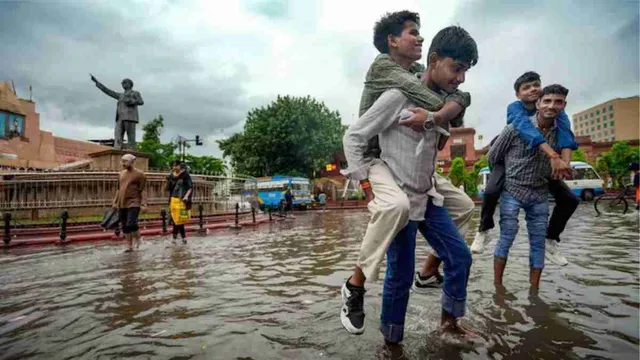
Rains in India bring to the fore a classic contradiction. Relief and misery, ecstasy and agony come wedded together. This contrast is a lived reality for the citizenry; the dilemma whether to rejoice or rue has become an annual phenomenon.
Writers have their own quandary. Those writing regular columns have the convenience of being sure of the subject of a few write-ups; the difficulty, though, is to think of new, impressive tropes to echo the angst, for all literary flourish seems to have been exhausted.
But as they say, you have to do what you have to do. Monsoon mayhem and the concomitant exasperation and irk reflect the zeitgeist of the season. When the ‘what’ is so compelling, writers invariably discover the 'how' to communicate.
It has been said ad nauseam that our cities are amongst the filthiest in the world. A critical, underlying cause is the inadequacy of our municipal plumbing. Data indicates that several urban towns operate at less than 50% sewage network capacity. Sewage lines and piped connections are missing across vast areas, and treatment capacity remains woefully short.
Stormwater drains, meant strictly to carry excess rainwater, are instead routinely laden with untreated sewage and industrial waste. These open drains merge into our rivers, which, in certain stretches, become visually indistinguishable from the drains themselves.
Yes, there are major state interventions under schemes like Namami Gange, for example, to treat sewage right before it flows into the main river channel. While that helps mitigate river pollution at the confluence, the everyday hazard of open sewage flowing through the length and breadth of a city has a sordid effect.
Air pollution, groundwater contamination, soil toxicity, and an array of bacterial, fungal, and vector-borne diseases are the obvious outcomes. Under these conditions, "Open Defecation Free" declarations seem a far cry from the complex ground realities.
The problem is apparent; the solution seemingly straightforward; yet, what remains puzzling is the collective apathy. Don’t we deserve livable, clean, hygienic cities comparable with the world's best? Can this be achieved without ensuring zero tolerance for untreated civic discharge? Our country must actively pursue near-universal sewage networks.
It cannot happen overnight, but sustained and accelerated efforts have to be made. It has to start with a phased approach, beginning from the top 100 cities, the proverbial engines of growth, and systematically expanding to cover all urban and rural settlements.
Paucity of funds is routinely cited as an impediment, but that really is a prevarication. Let’s sample a typical tier-2 or tier-3 town currently operating with less than half its sewage network covered. A broad estimate is that it may require an investment of around Rs 5,000 crore to upgrade toward cent-per cent compliance.
This implies creating an integrated drainage system where dedicated pipelines cover the entire urban layout, directing all waste through regional treatment units where it is recycled and discharged safely. Under various national sanitation frameworks, the fiscal burden is to be shared by the central government, state governments, and urban local bodies.
Consider the macro-level numbers for context: the combined annual expenditure across these three tiers of Indian governance hovers near an estimated Rs 100 lakh crore. The construction timeline for laying down such a mammoth underground network would realistically take a minimum of five years.
If we look specifically at the top 100 cities - our economic vanguards - the capital layout required to bring them to near-universal sewage compliance will be approximately Rs 5 lakh crore, disbursed over a five-year cycle. That amounts to roughly 5% of a single year's combined public expenditure, and a mere 1% of the total five-year government spend.
Simple arithmetic suggests that if the three tiers of government pan-India were to dedicate 1% of their annual expenditure to sewage infrastructure in these 100 major towns, cent-per-cent compliance could realistically be achieved in five years across our primary economic zones. While execution bottlenecks, land acquisition, and bureaucratic overlapping between municipal agencies may pose practical hurdles, the fundamental financial math is entirely viable.
With three-fourths of India governed by the same ruling dispensation at the Centre and the states, the so-called "double-engine" government, and with the same political alignment extending down to the municipal level in several regions, a formidable "triple-engine" model is said to be actively operative. Should this urban transformation then not be attainable? If governance is aligned across different tiers, should execution not become easier? If not, what continues to impede progress? Is it lack of resources, or lack of political will?
Public policy should often focus on high-impact interventions. This is captured by the Pareto Principle, which states that roughly 80% of results flow from 20% of the core factors. The policy implication is clear: if you target the right 20%, you drastically upgrade 80% of the overall outcomes. Sanitation is undoubtedly one of those high-impact foundational variables.
It has a direct bearing on various social indices - quality of human life and the Human Development Index. Importantly, the long-term cost-benefit analysis in terms of improved economic productivity and reduced healthcare burdens will far outweigh the initial capital payout.
For any developing nation, the magic five of robust governance must be: education, health, infrastructure, law and order, and comprehensive sanitation. The transition from a developing to a developed economy will remain incomplete until we achieve first-world standards across these five spheres. Foreign capital, private investments, and domestic productivity all have an inextricable connection with these overarching aspects.
Often in an intense electoral democracy, short-term populist measures that yield immediate political dividends are prioritised over long-gestation infrastructure projects. It then becomes incumbent on the citizenry to actively shape the narrative, forcing public priorities into proper perspective. While we hold the executive accountable, let’s also be mindful that generations of Augean dirt cannot be cleaned without community integration.
(Note: The author is the Managing Editor of Dainik Jagran.)