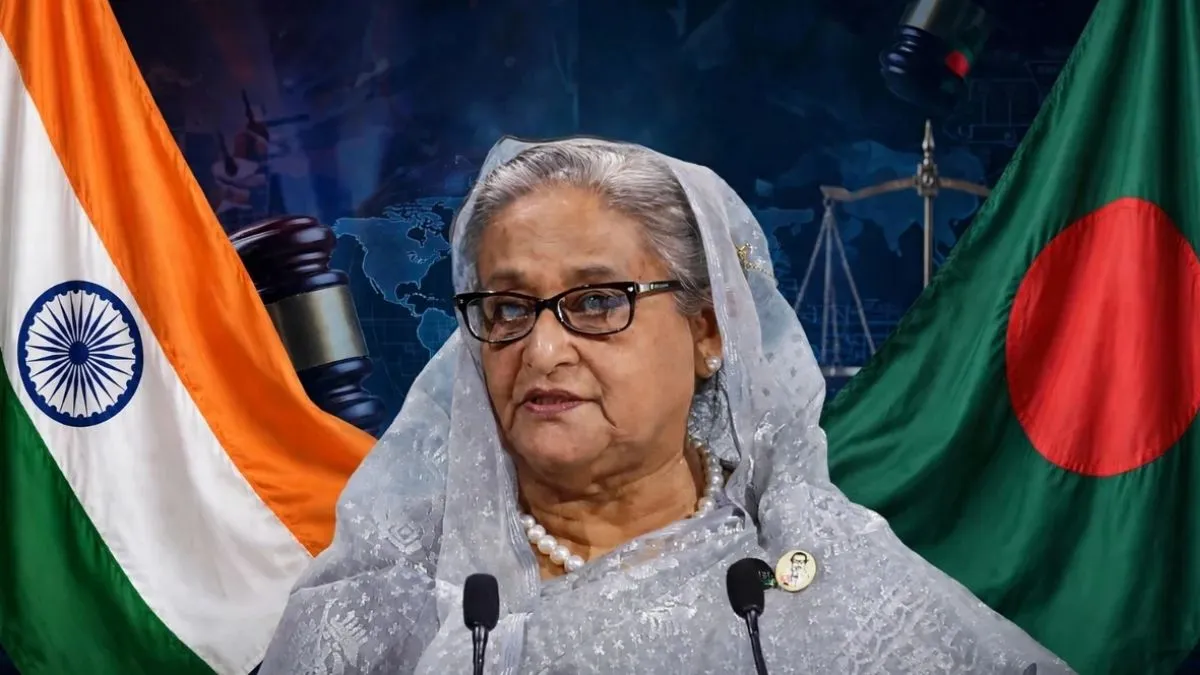
- Bangladesh threatens ICJ move if India refuses Hasina's extradition.
- India's Commonwealth reservation complicates ICJ jurisdiction.
- The India-Bangladesh Extradition treaty provisions also offer grounds for refusal.
Bangladesh has warned that it could approach the International Court of Justice (ICJ) if India refuses to extradite former Prime Minister Sheikh Hasina. The warning was issued by Bangladesh Parliament Speaker Hafiz Uddin Ahmed during his six-day visit to Pakistan and comes amid Hasina's planned return on December 16, the country’s Victory Day. However, taking India to the ICJ may not be as simple as Dhaka suggests as several legal hurdles stand in the way.
Bangladesh Threatens ICJ Move
Speaking to journalists in Islamabad, Ahmed said Bangladesh could move the ICJ if India failed to hand over Hasina. He also said Hasina would be arrested and sent to prison if she returned to Bangladesh. Hasina has been living in India since August 2024, following the fall of her government after a student-led uprising. His remarks come as Bangladesh has been seeking her extradition from India, but New Delhi has not announced a final decision. The speaker's warning has now raised an important question: Can Bangladesh take India to the ICJ over the matter?
Can Dhaka Approach ICJ?
The biggest obstacle for Bangladesh remains India's declaration on the ICJ's compulsory jurisdiction. While India accepts the court's authority under certain conditions, it has also made specific exceptions. One such exception relates to disputes involving countries that are current or former members of the Commonwealth of Nations. As Bangladesh is a Commonwealth member, India can use this reservation to challenge the ICJ's jurisdiction if Dhaka files a case against it.
Recommended For You
It implies that while Bangladesh may submit an application, it does not mean the ICJ will automatically agree to hear it. The court must first establish whether it has the legal authority to deal with the dispute and without a valid basis for jurisdiction, the case cannot proceed.
Pakistan Faced A Similar Hurdle In 2000
India's Commonwealth-related reservation is not a new legal argument. Pakistan faced a similar situation when it approached the ICJ against India in 1999 over an aerial incident involving a Pakistani aircraft. India challenged the court's jurisdiction, pointing to its reservation on Commonwealth countries. In June 2000, the ICJ ruled that it did not have jurisdiction to hear Pakistan's case.
India-Bangladesh Extradition Also In Focus
The discussion has also brought focus to an extradition treaty signed by India and Bangladesh in January 2013. This agreement provides a legal framework for both countries to hand over people wanted for criminal proceedings or to serve sentences, subject to certain conditions.
Article 1 deals with the obligation to extradite, while Article 2 states that an offence generally qualifies for extradition if it carries a punishment of at least one year in prison under the laws of both countries.
However, the treaty also provides grounds on which a country can refuse an extradition request. It also does not contain a specific provision allowing either country to unilaterally take an extradition dispute to the ICJ. Article 20 states that the treaty does not affect the rights and obligations of either country under other international agreements.
Can India Refuse To Extradite Sheikh Hasina?
The treaty also contains provisions that could become important in Hasina's case. Article 6 allows a country to refuse extradition if the offence is considered political in nature. However, it also lists certain serious crimes, including murder and culpable homicide, that cannot be treated as political offences under this exception. Article 8 provides additional grounds for refusing extradition, including situations where handing over a person could be considered unjust or oppressive, or where the accusation is not made in good faith in the interests of justice.
India's Stand On Hasina's Extradition
These provisions could become relevant as India examines Bangladesh's request. As Hasina's case involves a trial and death sentence in absentia, it remains to be seen how India moves ahead with the request. Meanwhile, India has maintained that Bangladesh's extradition request is being examined through established legal procedures. During a press briefing on Wednesday, the Ministry of External Affairs (MEA) spokesperson Randhir Jaiswal reiterated that the request was being considered under the existing processes.
VIDEO | Delhi: MEA spokesperson Randhir Jaiswal, on the extradition of Sheikh Hasina, says, "...This is a legal matter, and the issue will be dealt with accordingly. Now, obviously, for people to travel, they need a travel document. That is what I understand. But again, this is a technical matter..."
— Press Trust of India (@PTI_News) November 10, 2026
He also clarified that Hasina's possible voluntary return to Bangladesh using the required travel documents would be a separate matter from the extradition request. New Delhi has not yet announced a final decision on whether it will hand over the former prime minister.
The current situation indicates that while Bangladesh can attempt to file a case, getting the ICJ to hear remains a different challenge. The absence of a specific ICJ provision in the extradition treaty and India's Commonwealth reservation stand as major legal obstacles. As of now, it remains to be seen whether India will approve Bangladesh's extradition request under the existing treaty.
You May Also Like To Watch: